Semi-Autonomous R2D2
Our first big adventure as the Raising Awesome team was the making of a full scale, semi-autonomous R2D2. This blog covers the details of such an ambitious build.
Sean and Connor Miller
Introduction
Back in the very early 80's, Walnut gazed blankly at a tree stump. He dreamed about taking a chainsaw to the bottom of the stump, hollowing it out, and using that as the foundation for a full size R2D2. That dream didn't become reality for 30 years until his own son turned 6.
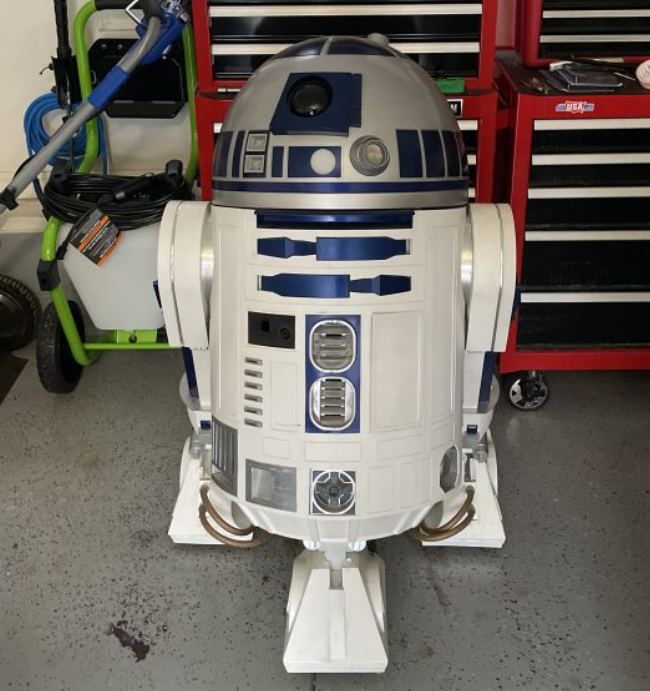
They were looking a behind-the-scenes pictures of R2D2 disassembled. They got to talking and before you know it, they were in the garage. This pre-dated them being able to afford a 3D printer, so every part was made by hand - with a birch frame. They then honed a ton of skills of fabrication such as welding, machining, plastic fabrication, PCB fabrication, and microcontroller coding, etc.
This blog collects the various published build logs for that journey to a full sized, semi-autonomous build.
R2D2 Leg, Skirt, and Skins Construction
The legs had to be stout to hold the birch frame, heavy batteries, and all the electronics. The Skirt at the bottom of the frame is the major component for lifting him into a vehicle for transport, so it, too, needed to be stout. The skins were meticuously cut out by hand out of High Impact Polystyrene - the same stuff the movie-prop makers would use.
Dome Construction
The dome contained several challenges. First - it was a two part vacuum molded part. This had to be fabricated by first seeking others who wished to have one and making a parts run at a fab shop. This allowed it to be affordable. With the raw, two part dome in hand, we then cut and glued and designed the appropriate parts, leds, and hinges around it.
One thing to note - back then, AutoDesk Fusion 360 did not yet exist. Since we were on a very limited budget, we used a very early version of Blender and exploited its animation capabilities to verify our geometries prior to construction. (The mother of invention is necessity.)
Gizmos
This is very nostalgic to look back on today. Now with a 3D printer, you can just search online, find a part, and click print. Back then, you were making prototype parts from clay, casting a mold, and then producing the part. You had to fabricate jigs and props to achieve the geometries. The effort made such a build very special to us, actually.
Feet and Drives
The feet had to be able to drive around a 90 lb droid with ease and capable of stopping on a dime as not to run over any toddlers. So, we put a proximity sensor in the front that would interlock his drive system. We hid the motors in the "battery boxes" and the batteries in his belly.
Controls
We explored Xbee radio devices, building our own remote that would fit in our pocket to hide who was controlling him. His dome was autonomously controlled responding to proximity with different sounds and panel animations.
Summary
The R2D2 project took over 2 years to execute around work and school activities. However, it served as an amazing father and son project, each learning new skills that leveled them both up for life. We look back to the hand made parts that pre-dated 3D printing with great nostalgia and respect for how technology today has now allowed for incredible innovation.